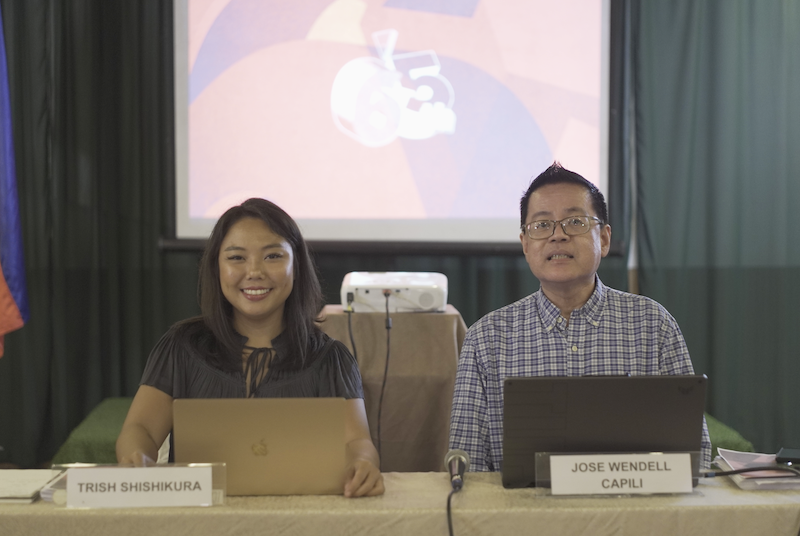
Workshop Session 2: Skincare Routine in the Afterlife by Trish Shishikura
Moderator: Dr. Wendell Capili
Written by Danielle Veniegas
“One claim underneath all of it: a poet’s material is not chosen. It is the ground you were standing on before you knew you were a writer—and the craft is what lets someone else stand there too.”
In his craft lecture, “The Ghost Note,” Dr. Wendell Capili impressed the importance of the writer’s own personal experiences and positionality to their craft—as the “ground” on which the seeds of their writing germinate and unfold. He introduced Shishikura, a Japanese-Filipino poet, as writing from “the margins of the diaspora”; while her poetry suite Skincare Routine in the Afterlife draws on her own experiences of loss and grief, it also deftly weaves broader themes of global displacement, domestic instability, and neurodivergence. In championing the suspension of immediate judgment and curation, Shishikura’s suite demonstrates “…how art can survive catastrophe without aestheticizing it.”
As a commercial photographer by trade, Shishikura described Skincare Routine in the Afterlife as her attempt to both expand and depart from her vocation. While the poetry suite is interspersed with photographs she has taken, these serve as neither illustrations nor ekphrasis; rather, both image and text construct meaning “on the same plane.” Of her central conceit, Shishikura explained her conception of skincare and other such grounding practices as mitigating the distorting abilities of trauma and pain, which tend to compromise human perception—“Everything feels so much more.”
Skincare Routine in the Afterlife drew much praise for its emotionality, with Dr. Jun Cruz Reyes describing the depth and restraint as “controlled grief.” Fellows such as Gita Labrador and Jan Dennis Destajo also commended the suite for being accessible without coddling or patronizing readers, serving as a good entry point to more complex, experimental poetry. Meanwhile, Dr. Vim Nadera expressed his appreciation for the suite’s meaningful gaps and dualities: photography and poetry, Filipino and Japanese, male and female, the old and the new. He also noted the power—and limitations—of art and poetry in serving as one’s existential refuge.
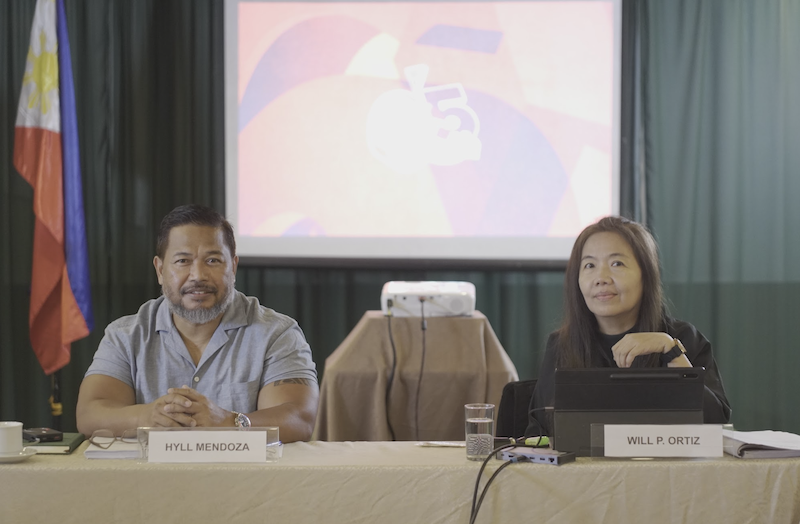
One point of criticism, voiced by Hyll Mendoza, is the too-loose association between image and text, noting that the poems can simply “stand alone.” Drawing from his extensive experience with picture books, Dr. Eugene Evasco advised Shishikura to perhaps bring more playfulness and intention to the suite’s image-text relationship. Both Evasco and Dr. Will Ortiz also suggested that she explore Filipino terminologies and rituals of mourning, such as “pagpag” and “babang luksa.”
In response to fellows Gerome Dela Peña’s and Amanda Echanis’ suggestion that she also develop themes of healing and restoration, Trish Shishikura confirmed that such an arc already exists across her larger project—a book-length manuscript of poetry. To close the session, Trish Shishikura thanked the fellows and panelists for their feedback, revealing that she has always intended the project to document the parallel journeys between those who have departed and those left behind.