Workshop Session 6, 65th UPNWW: Within Earshot by Jan Dennis Destajo, Fellow for Poetry
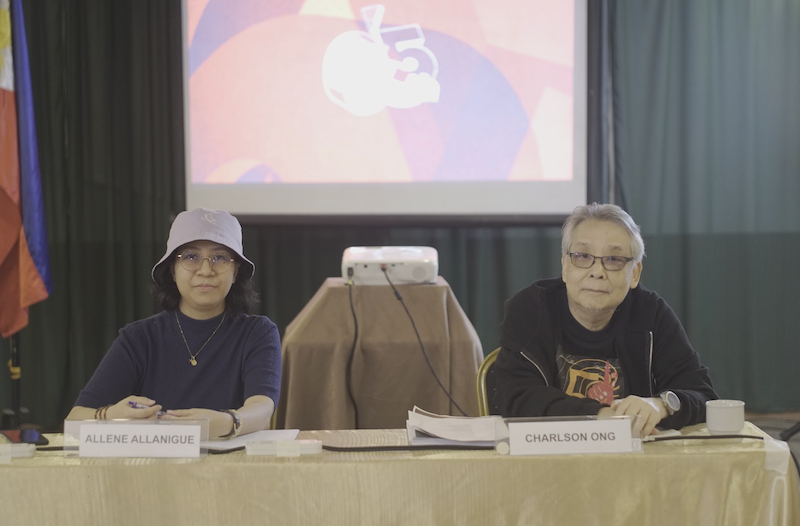
Moderator: Vim Nadera
Written by Danielle Veniegas
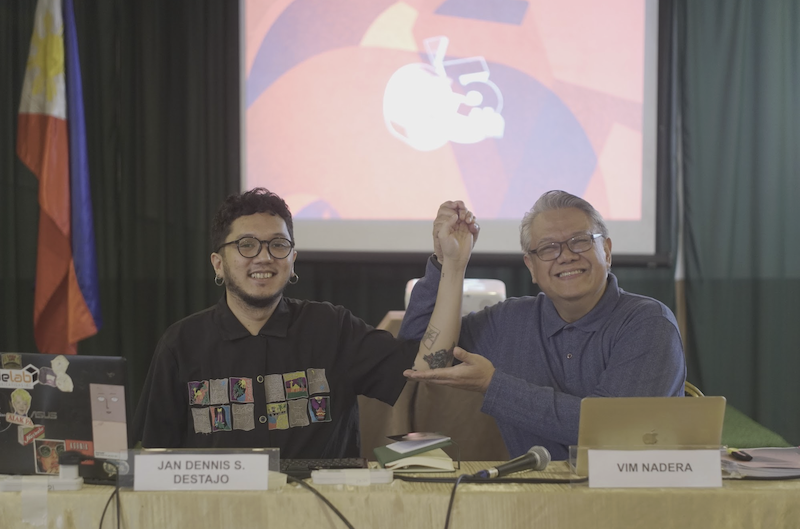
Dr. Victor Emmanuel “Vim” Nadera Jr. introduced fellow Jan Dennis Destajo as an architect-poet, or “archi-poet,” outlining the latter’s career milestones and achievements in both the fields of creative writing and architecture. As primer to Destajo’s poetry suite Within Earshot, Nadera traced the development of Philippine poetry in English, from its foray into modernism during the 1920s and 1930s to the craft’s full-blooded maturation in the 1950s and onward, listing key figures such as Amador Daguio, José García Villa, Angela Manalang Gloria, and Trinidad Tarrosa.
Drawing on Oscar Newman’s defensible space theory and the central conceit of Allen Grossman’s “The Caedmon Room,” Destajo expressed his fascination with the tension between the virtual poem and the actual poem—the latter as the failed realization of the former, an impossible and ever-fallible project of conveying pure, divine truths using the “fallen materials of language and history.” He described Within Earshot as a decade-long project of deferring and mediating the actual through the “permeable boundaries” of craft: strategies in form, technique, and language—“A poet is someone opening a window.”
Fellow Andrew Clete described the suite as employing an architecture, rather than an economy, of words—“Dahil sa pagsasalansan nito, nakabuo ng tahanan ng kahulugan kung saan ang mga mambabasa ay puwedeng manandaliang manirahan.” Trish Shishikura and Leonard Javier had similar praise for the language, with the former describing it as beautifully imagistic, “maximalist.” Meanwhile, Luna Sicat Cleto commended the suite as an ambitious, erudite project, able to engage with philosophical and critical material without becoming pedantic—noting, in particular, its profound traversal between personal and political notions of sovereignty. Dr. Wendell Capili also pointed out the suite’s critical engagement with the “politics of extraction and shelter” in urban spaces.
As to the possible direction or trajectory of the suite, Gita Labrador suggested further pulling at its stray threads of ecocriticism. Dr. Vladimeir Gonzales also inquired if there is space in the suite for engaging with home ownership—particularly, its associated aspirations of upper middle-class mobility and the contained dramas and conflicts that unfold with regard to the home.
Dr. Eugene Evasco noted Destajo’s suite as part of a broader theme of the 65th UP National Writers Worskshop: fellows who are not primarily writers approaching the craft of writing from their respective fields, from healthcare and social work to photography and architecture. However, he also implored Destajo to ground his poetry, an often lofty, intimidating form, with Filipino design concepts and realities—“tulaan mo rin ang bahay kubo.”
While Destajo acknowledged that a common criticism of his writing is its perceived lack of “Filipino-ness,” he also expressed a personal resistance to the “cliched” bahay kubo and tropical design. Closing the workshop session, the archi-poet professed that, despite his prominent foreign influences, he has been striving to write in Filipino.