Poetry and What We Let Out
Thieves broke into our (my grandmother’s) house in Daet in the middle of the night this January. My elderly uncle was the only one staying inside. They took an old flatscreen TV and a couple of watches that my uncle owned. Many of us grew up in that house: my mother, my aunts, my sisters, my cousins. For the longest time, the house looked old despite being relatively new in the 80s, or rather, it seemed unfinished, because it was. Despite the raw concrete, because of the vegetation, it felt intentional to my eyes as a toddler. “Pinoy Brutalist,” as I jokingly called it when I started architecture school. When I officially moved there after my mother went abroad, it slowly gained some color. And then some metal grill-work around the terrace. The shy, bare concrete suddenly became a rainbow palette. There were a lot of children inside, my cousins and I, but it wasn’t a nursery or kindergarten school.
When I went to college, I rarely went back. When I got the news that I was going to become an architect, I was back home, in my grandmother’s wake. My aunt, Mama’s elder sister, now owns that house. No one really stays there anymore. Everything started to fall apart; the column by the stairs started buckling around ten years ago. Then followed the chipping of the ceiling slab. Then the leaks. And despite it looking like a decrepit cage, it wasn’t immune to crime.
Architect and city planner Oscar Newman, whom I discovered in planning class, coined the theory of “defensible space” in the 70s, around the time of cities becoming more accommodating to vertical developments. He advocated for clear demarcations between public, semi-private, and private spaces, which started to blur in the beginning of mixed-use developments, and by defining such, empowers residents to control their environment. I simply view it as private property being non-existent, visually at least. What I mean is that providing exaggerated privacy and protection around a boundary, in this case, the lot containing a house, is more damaging and more prone to crime. Our home, despite its metal grills and gates, didn’t keep the thieves away.
Newman argued that the physical geometry of housing, specifically its height and orientation, could weaponize visibility by encouraging residents to police their own surroundings simply by looking out the window. Jokingly, a teacher from my ALE review class said that’s the reason why chismosas are essential. They’re actually keeping a community safe. You leave bits of your house open. Visible. A permeable boundary. So that the town’s gossip will see through. When something suddenly changes, they’ll think that something must be wrong. You close it off completely, and no one, not even gossip, will be there to protect you.
The longer I am in my architecture career, the more I start to think in this sequence, especially in poetry. Craft is the levels or the buffers you surround yourself with: the form, the technique, and the language. I treat those as sieves until a real poem leaks out of the house. The noise level allowed to be heard by the neighborhood. A poet is someone opening a window.
Poetry, in my life, has been a constant despite the resistance to calling myself a poet. It has existed since the fourth grade, when my aunt ghostwrote my English assignment for me. We were asked to write a poem, with the promise that the best one would be submitted to the education magazines distributed in schools. Unfortunately, mine was picked: my aunt’s work, typed out on our first family computer. Fortunately, the work was never selected by the magazine, or perhaps my teacher simply forgot to send it. But by that point, the facade was built. I became the designated poet. I had to act the part.
This resistance or this feeling of being a fraud is made more potent by the long struggle of accepting failure, in general, and of poetry, or the notion of its bitter logic. Through Bede’s account of Caedmon, and his other essays on Walt Whitman and Hart Crane, Allen Grossman explains this notion by how poems will always be a product of failure, akin to the myth that Caedmon, the first poet in English, could never put what he saw in his dream into song. As he writes in The Caedmon Room—a text I pinned as the epigraph to my own poem—”…What he sang, in his / own language, was consequential—because / he did not learn the art of poetry / from men, but from God.”
In Grossman’s theory, the dream is what he calls the virtual poem, and it is impossible. It is the divine desire to transcend representation, to speak the pure truth without the corruption of words. Where Caedmon failed is the actual poem, what we are forced to write using the fallen materials of language and history. The realization that the Actual always betrays the Virtual is where we find the attempt of a poet to be a bitter one.
The attempt in this manuscript is to ask what if we build the actual poem with enough permeability? It might not only fail; we may also create a space, something architectural, for the virtual, and the possibility for it to be felt, even if it cannot be seen.
It is with this blueprint that I organized the manuscript. Although these poems were written over a span of ten years, their arrangement is not chronological but architectural. It forms a narrative arc not of time, but of the changing attempts and strategies I have used to defer the actuality, to keep the raw, overwhelming truth at a safe distance through the mediation of technique.
The collection begins with an attempt to imagine the virtual in its purest form, in the spirit of a place where the intrusion of the actual in poems like “Secondhand” is met with surrealism, refusing to let the wound settle into a mere medical fact. This defensive posture then cures its way into the second section with focused architectural rigor, where the structure is not meant to finish the building but to prolong its potential; in “Abang,” the exposed rebar is made deliberate to keep the virtual second floor a possibility rather than a failed reality. Yet, as the poems progress, in the third section, actuality inevitably seeps in through the noise and clutter of daily life. Here, dictation poetry, as heavily influenced by Jack Spicer, is the obvious choice; the act of something taking over can be argued to be already deferring the actuality. Such arrogance becomes a driving force, a strategic withdrawal. Ultimately, the collection moves into a study of the end in the fourth section, where poems like “My Whitest Shirt” track the degradation of objects not as ruin, but as proof that a pure state once existed, and in “Circle the Drain,” the scent leaking out serves as the final point that the virtual could be possible.
Much to my resistance, I cannot help but view poetry through architectural language. In my career, what architects imagine is bound by math and logic; it moves to paper, and only then can it exist to be lived. Writing this poetics essay made me see the manuscript as an attempt to treat poetry with that same tactility. Ironically, the persistence of poetry in my mind is its own way of actualizing.
After my grandmother died, I kept getting asked how to repair the house in Daet. I keep telling everyone that it will cost too much. It is a practical answer, but it carries a heavy implication: that to truly restore the home is impossible. Each of our imagined realities and memories can be left to the sandman when we dream. I could go all avant-garde and say that the truest way is to move away from it altogether. So, in that way, it is real, away from the actual reality of thieves crawling at night. I have oscillated between architect and poet for years, often told that my profession is an art, yet finding myself bound by the tactile realities of science and capitalism. I am the sum of what the people before me have built, and my thoughts have become load-bearing structures cast by market forces that leave no allowance for failure. To even attempt is such a daunting task. But it is the burden that the only architect in the family (everyone in the family is in healthcare) has to carry, to find a place for the truth: everyone is getting older, we all have our own obligations, and everything will pass. And maybe someday, inside there is someone attempting to write a poem for their nephew beside a window against a nightlight. And somewhere outside, someone hears and questions the reason for that much clacking sound out of the keyboard.
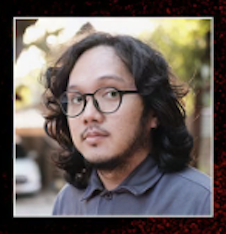
ABOUT THE AUTHOR
Jan Dennis Destajo is an architect from Daet, Camarines Norte, Philippines. He received awards and recognitions such as the First Prize for Poetry at the Carlos Palanca Memorial Awards for Literature, Finalist at the 2024 Gaudy Boy Poetry Prize, 2023 Maningning Miclat Grand Prize for Poetry, the 2022 Bess Hokin Prize from the Poetry Foundation, and the First Prize at the 32nd Gawad Ustetika for English Poetry. His works have appeared and are forthcoming in several literary journals, including 5×5, Consequence Forum, Hoxie Gorge Review, Poetry Magazine, TLDTD, and more. He works and resides in Pasig City.
Workshop Session 6, 65th UPNWW: Within Earshot by Jan Dennis Destajo, Fellow for Poetry