Session 2: Shortcut
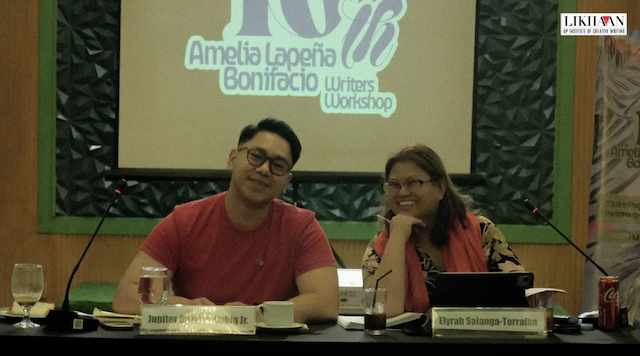
Fellow: Jupiter Dumlao Cabig, Jr.
Moderator: Elyrah Salanga-Torralba
“Mga blangkong espasyo, may sariling kairalan. Bahagi ng tanong o pangungusap, at kasama sa ating binabasa.”
In her craft lecture “Filling in The Blanks,” Dr. Elyrah Salanga-Torralba likened Jupiter Dumlao Cabig Jr.’s “Shortcut” to blank forms—deceptively simple, yet laden with strategic silences that endow readers with the meaningful choice of what, how, and whether to fill such gaps. While on the surface a straightforward narrative of domestic abuse and intergenerational trauma, Salanga-Torralba insisted that the work’s silences lend its serious themes proper weight and dignity without melodramatics. What she views as the work’s strength—its “emotional resonance”—is only possible through such a precise, calculated vacuum.
Most of the fellows had similar praise for Cabig’s work, particularly for his deft hand with worldbuilding and descriptions of setting. Another commended aspect was its tensioned build-up leading up to such a powerful, cathartic conclusion. “Shortcut,” as Kalay Brillo pointed out, could also resonate powerfully with teenaged readers in its rendering of angst and complex family dynamics. Meanwhile, Khristina Alvarez commended Cabig’s inclusion of stigmatized illnesses such as clinical anxiety and eczema, describing the creative choice as “risky but necessary.”
Despite the work’s main protagonist being a queer, disabled individual suffering from mental illness, however, fellows Alpine Moldez and Ashley Cua pointed out how such character aspects were not sufficiently explored. Some fellows also took issue with the stilted, overly formal dialogue—perhaps unsuited to the intimate or familial relationships depicted in the work.
Contrary to the fellows’ mostly positive reception of “Shortcut”’s dramatic crescendo, panelists Will Ortiz and Luna Sicat Cleto felt its depiction of retribution too cruel to be liberating or empowering—with the latter quoting Black feminist Audre Lorde: “The master’s tools will never dismantle the master’s house.” Eugene Evasco, meanwhile, interpreted the work’s much-praised silences to be actual gaps of information to be addressed. Finally, Lalaine Yanilla-Aquino advised budding writers to be more intentional with their word collocations and use of verb tenses.
Fellow Jupiter Dumlao Cabig Jr. thanked the fellows and panelists for their thoughtful critiques, revealing that “Shortcut” was the first story he’s ever written. In answering for the work’s underdeveloped aspects, he explained that the oversight perhaps stemmed from his desire to enmesh multiple themes—queerness, disability, and a mother’s quiet suffering. He ended the session in hopeful anticipation of writing more about the subject matters near and dear to his heart.