Session 5: Bayani
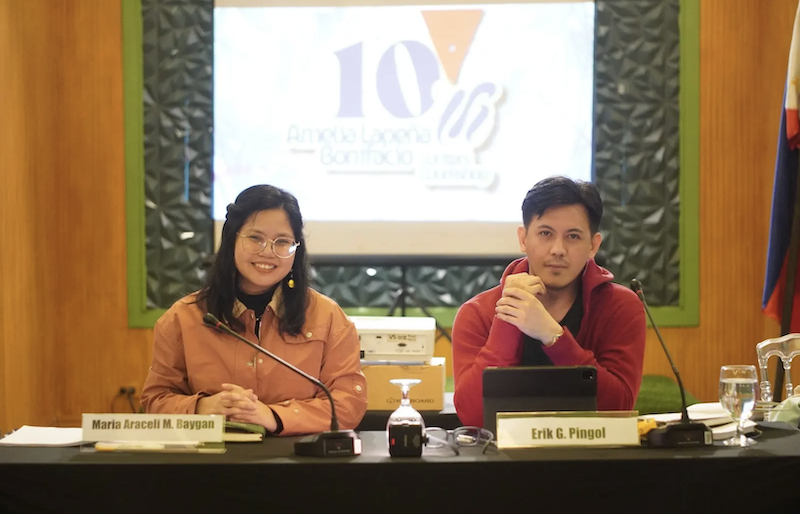
Fellow: Maria Araceli M. Baygan
Moderator: Erik Pingol
“We see that the more fantastic the world, the more urgently it speaks to the political realities of our own.”
In his craft lecture, “The Politics of the Fantastic,” Erik Pingol questioned how fantasy fiction is often associated with escapism—the idea that such writers and readers simply endeavor to “escape into other worlds away from ours.” Citing fellow Maria Araceli Baygan’s novel-in-progress Bayani as a positive example, he affirmed the potent capacity of fantasy fiction to confront real-life adversities—couching such realities in colorful, imaginative ways to more effectively engage young readers. Pingol also highlighted the genre’s significant role in endowing children with the tools to process, analyze, and respond to the real-world injustices they will eventually encounter.
Having grown up with primarily Anglo-American urban fantasy fiction, fellow Ashley Cua expressed her excitement over Baygan’s invigorating localization of the genre. Other fellows also commended the work’s thoughtful integration of Philippine folklore, with Khristina Alvarez describing the worldbuilding as hopeful and embodied, not simply a “passive vehicle for nostalgia.” Similarly praised was how the work’s folkloric elements engaged with serious issues such as environmental sustainability and class relations.
Several panelists discussed aspects of the work that could be developed further. Elyrah Salanga-Torralba advised Baygan to lend the appropriate weight and detail to “weaving,” as it is touted in the work as a form of “spiritual magic.” She also suggested that “weaving” be expanded past the plot and into the work’s narrative structure and style. In addition, Lalaine Yanilla-Aquino urged Baygan to refine the work’s notion of the spiritual: “Is it pre-colonial? Post-colonial?”
Of the work’s incorporation of Philippine mythical figure Alunsina, Eugene Evasco cited Rene Villanueva’s “Tungkung Langit at Alunsina” as one retelling to perhaps emulate in its meaningful intent and purposefulness. Will Ortiz contended, however, that there are “no hard and fast rules” in such retellings, as long as metaphorical significance is retained. Meanwhile, Luna Sicat Cleto expressed her appreciation for the work’s elevation of Alunsina to a principal deity, encouraging Baygan to expound on the in-world implications of this—won’t Alunsina’s nurturing, generous aspect also be reflected in the world she presides over?
Closing the session, fellow Maria Araceli Baygan revealed that the work is a response to the destruction of our natural resources, as she witnessed firsthand in her hometown of Bohol. She explained that her depiction of magic as both “craft and practice” is meant to inculcate readers with the value of community, perseverance, and their own agency in the face of real-world adversities: “…paano [sila] mabibigyan ng tapang?”