Session 3: Istorya Gahum: The Magical Errands of Kulas Buencamino
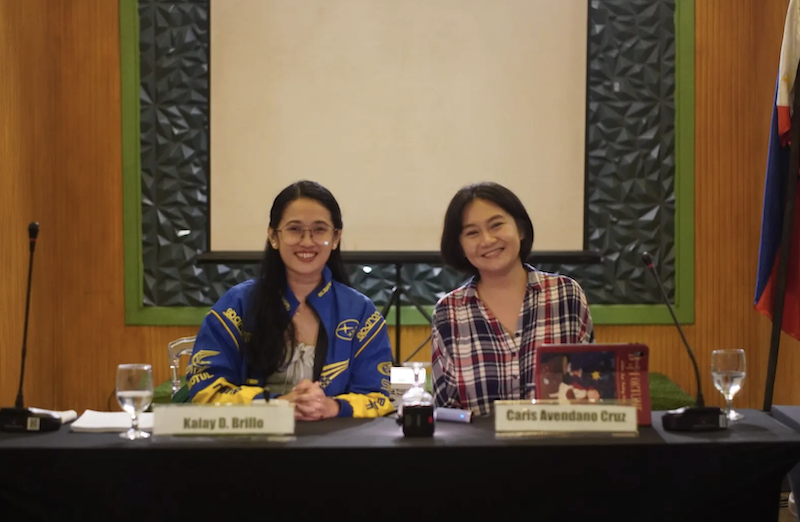
Fellow: Kharla “Kalay” Brillo
Moderator: Caris Avendano Cruz
“We are a nation of storytellers. From the humble made-up anecdotes we invent for someone to laugh, to the night-time legends to lure little heads to sleep, we have always been telling stories since the time of old. Napaka-galing natin dito.”
Caris Avendano Cruz introduced Kharla “Kalay” Brillo’s novel-in-progress Istorya Gahum: The Magical Errands of Kulas Buencamino with a call for much-needed representation, insisting that the current milieu is ripe for centering the oft-overlooked aspects of Philippine culture and heritage in our own stories. In her craft lecture, “Fill the Page (A Short Pep Talk Re: Writing With Our Language),” Cruz pointed out how American fantasy writers such as George R.R. Martin had to invent fictional languages as part of their worldbuilding, but Filipino writers can simply draw on our country’s rich, “boundless” trove of cultures—precisely one of the central strengths of Istorya Gahum, it being a love letter to Hiligaynon culture, particularly its language and oral traditions.
One of the central aspects of the work, its deep-rooted integration of the Hiligaynon language, drew mixed reception from the workshop fellows and panel. While Lari Sabangan and Christopher Rosales suggested that Brillo be more consistent with the use of either direct translation, footnotes, or simply context clues, fellows such as Khristina Alvarez appreciated the “delightful sense of disorientation” such inconsistencies create, asserting that minority fiction should not have to make itself digestible or overtly educational.
Drawing from his extensive experience with the publishing industry, Eugene Evasco advised Brillo to write the work in either Hiligaynon or English more strategically interspersed with Hiligaynon. Both Evasco and Elyrah Salanga-Torralba also critiqued the work as lacking in magic or a “sense of wonder,” considering the fantastical promise of its title. Luna Sicet Cleto noted the work’s descriptive emphasis on the colors of the surroundings, suggesting that this might be the key to developing its missing “sense of wonder.”
Lastly, Will Ortiz addressed the alleged tension between the languages Hiligaynon and Filipino, as mentioned in Brillo’s poetics. Ortiz maintained that Brillo’s work is, in fact, Filipino—being an amalgamation of different languages in the Philippines.
To end the session, fellow Kharla Brillo revealed that she has put considerable thought into the social and political implications of the work’s multilingual aspect. She explained that stories written in full Hiligaynon are often intimidating even for native speakers—her target audience—and that her primary concern is “…papaano ko [sila] bibigyan ng angkla, or anchor, paano ko sila tutulungang makauwi.”